Understanding China’s Public Hospitals
China’s public hospitals sit at the centre of the country’s healthcare system. Major general hospitals, university hospitals and public specialist centres bring together much of the country’s medical expertise. Their work spans everyday care, complex illness, medical education and research, and public service remains a central aim of healthcare reform.1 For patients considering treatment in China, the appeal lies in that expertise, in the cost of certain medical implants and in the way hospitals work under sustained demand. Patients also need to know how to prepare, what to expect while they are there and who will look after them once they are home.
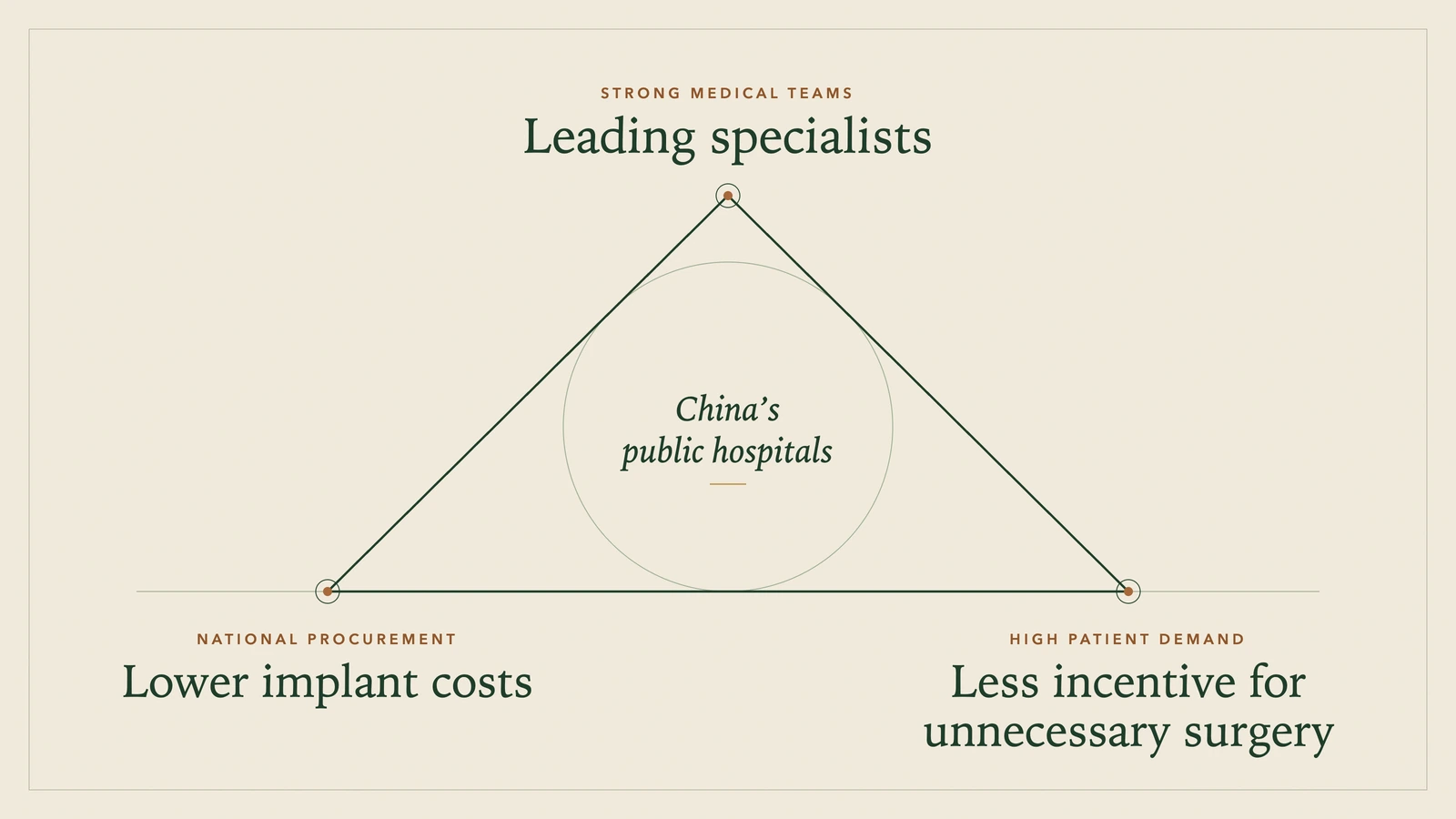
Leading specialists backed by strong medical teams
Many of China’s leading doctors work in large public hospitals, where clinical practice, teaching and research support a long process of professional training. The country’s “5+3” model, set out in a 2017 State Council policy, combines five years of undergraduate medicine with three years of standardised residency training or a professional master’s programme in clinical medicine. Together, those stages provide eight years of foundational education and training.3 Doctors go on from there to develop the skills of their specialty and the procedures they perform, and teaching and research keep that knowledge moving forward as experienced teams pass on what they have learnt.
The support around the surgeon matters just as much as the surgeon’s own skill. An operation can draw on imaging, pathology, anaesthesia, nursing and several other specialties, especially when a patient has more than one medical condition, and large public hospitals are where those teams come together. A surgical team can call on the tests, specialist advice and care a patient needs before and after an operation within the same hospital. That institutional backing is part of what makes an experienced doctor effective.
National procurement sharply lowers implant prices
Implants such as artificial lenses, hip and knee replacements, and coronary stents account for an important part of many treatments, and China buys them on a national scale. Its volume-based procurement programme pools hospitals’ demand and negotiates prices against committed purchasing volumes. In the first national round for joint implants in 2021, the average price of a hip implant fell from about RMB 35,000 to RMB 7,000, and a knee implant from about RMB 32,000 to RMB 5,000. Across joint implants, the overall average reduction was 82%.4 In the 2024 follow-on round, selected prices came down by a further 6% on average, with 167 products from 54 companies selected.5 That later round held the large initial savings in place while reducing prices further.
Coronary stents show a similar pattern. In its October 2026 review of China’s medical insurance system, the National Healthcare Security Administration reported that average stent prices had fallen from about RMB 13,000 to around RMB 700 under national procurement.7 Pooling demand gives hospitals a negotiating position they could not reach by buying individually, and public hospitals taking part in the programme can use implants purchased at those lower prices. Artificial lenses are among the other products included.2 For treatments that use these devices, that is a concrete cost advantage of being treated within China’s public hospital system.
High patient demand reduces the incentive for unnecessary surgery
The scale of demand shows up in hospitals’ annual activity figures. The Eye & ENT Hospital of Fudan University reported more than 3.44 million outpatient visits and over 205,000 operations across the whole hospital in 2025.6 Those are the figures for one specialist hospital over one year. With that many patients to treat, doctors’ time, theatre slots and beds all have to be carefully managed, and the daily challenge is to organise care for the patients already seeking treatment while making the best use of the capacity available.
That existing demand also shapes the incentive to take on more operations. A hospital already busy treating patients who need its services has less reason to encourage additional surgery by stretching the criteria for operating. The question at the centre of the consultation can stay clinical: whether surgery is warranted, whether observation would serve the patient better, or whether medication or rehabilitation should come first. The priority is to meet the demand that already exists.
Where the patient experience falls short
Strong clinical expertise does not always come with equally strong patient service. In busy public hospitals, processes are built around moving patients through consultations, tests and treatment efficiently, which leaves little time for extended conversations or personal guidance. International patients face further practical difficulties: language, appointments, medical records, communication between departments and understanding what has already been arranged. A hospital can provide excellent treatment while leaving the patient to organise much of the surrounding work in an unfamiliar setting.
The gaps are most noticeable before and after surgery. Before travelling, patients need a local assessment, records that allow the Chinese team to review their case and a clear discussion of whether an operation is appropriate. After returning home, someone has to take over routine follow-up, receive the treatment records and assess any problems or complications. A hospital’s own processes rarely cover all the care a patient needs across two countries, yet those connections shape how well patients understand their treatment, how prepared they feel and how they experience recovery. They are central to MediConnex’s work.
MediConnex: care before, during and after China
MediConnex organises the care around treatment, with particular attention to preparation and recovery. Through our local medical network, we connect healthcare providers in the patient’s home country with the team in China. Before travel, we arrange local assessment and bring together diagnoses, scans, test results and medication details for the Chinese doctors to review, and the two teams can discuss the reasons for surgery, the possible approaches and any further investigations in advance. Patients arrive with a clearer understanding of the proposed treatment and the preparation behind it.
During treatment in China, we coordinate appointments, language support, medical information and practical arrangements. We help patients understand their tests, their admission, the preparation for surgery and the discharge plan, and we pay attention to the points where people most often feel uncertain: what will happen before the operation, how to manage medication and recovery afterwards, and whom to contact with a question. Clear communication with the medical team is what turns a clinical plan into arrangements a patient can understand and follow.
Care after returning home is planned from the outset. We coordinate the handover of treatment summaries, operation records, medication changes and follow-up instructions to local healthcare providers, so patients can continue appointments and recovery close to home. If a problem needs further assessment, including a possible complication, we help connect the patient with an appropriate local doctor and liaise with the treating team in China. Patients can draw on China’s public hospital expertise while staying connected to care at home, with support from their first preparations through to recovery.
Considering treatment in China? Talk to MediConnex about your treatment options and how we can support you before, during and after your stay.
Book a free consultationSources
- State Council of the People’s Republic of China. Report on the National Health Conference, 13 October 2026. Original report.
- National Healthcare Security Administration. “Making healthcare more convenient, affordable and comfortable”, 9 April 2025. Original article.
- General Office of the State Council. Policy on medical education and collaboration between education and healthcare, 11 July 2017, document No. 63. Original policy.
- National Healthcare Security Administration. State Council policy briefing on the 14th Five-Year Plan for Universal Medical Security, 29 September 2021. Original briefing.
- National Healthcare Security Administration. Artificial-joint follow-on procurement results, 21 May 2024. Original release.
- Eye & ENT Hospital of Fudan University. Hospital overview, reporting 2025 activity. Hospital website. Accessed 15 October 2026.
- National Healthcare Security Administration. Review of the development of China’s healthcare insurance system, 11 October 2026. Original review.